

One senior producer owns your show from first call to final report. Their name is on the contract.
That producer is named on your contract, accountable for every decision from concept through strike. Scenic design, technical direction, show calling, run-of-show, and the 72-hour post-event report your exec sponsor walks back to the C-suite all answer to that one name. Hire us for the full stack, or bring us in as the production lead underneath your in-house team, in Houston or on the road.
This is for corporate event teams where the show has to be right the first time.
This is the right engagement when you need a senior producer named on the contract from day one, or when you’ve run events through a broker chain and watched quality slip every time a downstream crew made a call without the context to make it well. If a large staging company has already quoted you, look down the line items for the name of the person responsible when the keynote goes sideways at 9:04 a.m. It isn’t there. On our contract, it’s the first line.
- Annual corporate summits, multi-day agendas, general sessions, breakouts, executive reception
- User conferences & sales kickoffs, flagship keynotes, parallel tracks, sponsor showfloor
- Benefit galas & capital campaigns, donor-run show calling with paddle-raise choreography
- Product launches & reveals, cinematic staging with press-ready livestream
- Executive off-sites, discreet, confidentiality-aware production for board-level gatherings
You get six named roles, one senior producer, and one contract.
Every seat in the production org lives inside one contract, one budget, and one show-day production desk. When scope changes, your producer prices it with you on the spot, because one person owns both the creative call and the budget line.
Executive Producer
Your executive producer owns the relationship, the scope, and the budget, and is your first call on any strategic question, from venue choice to board-sensitive content decisions.
Producer
Your producer lives in your planning calls from week one and locks Tuesday production standups from week twelve forward. They own the run of show, the production schedule, the crew bench, and the on-site production desk on event day. Scope changes come to the producer first, not to your inbox via invoice.
Technical Director
Your technical director engineers the audio, video, lighting, and broadcast stack, and signs off on every site survey, every equipment list, and every failover plan. On event day, “the AV worked” is the only acceptable answer.
Show Caller
Your show caller runs the show from the production desk on event day, cueing every transition, every video insert, every mic, and every light move live on comms.
Scenic Designer
Your scenic designer draws the stage, signage, wayfinding, and environmental branding, translating your brand into a room your guests read the moment they walk through the door.
Content Lead
Your content lead builds the video, motion graphics, lower-thirds, walk-ins, and sponsor-branded elements, with show direction and brand narrative baked into every piece, not bolted on after the room is drawn.
Your brand has a story. We produce the room that makes it land.
Nobody in the room remembers the LED wall spec. They remember the moment the film landed, the lighting cue that turned a number into something people felt, and the run-of-show beat that put a decision-maker exactly where you needed them. Tell us what the room has to change (a renewal number, a donor target, a strategy your field force finally believes), and we engineer every cue backward from that. Then the 72-hour readout proves it moved, in the ten slides your exec sponsor presents on Monday.
- Show direction & brand narrativeWe shape the story the room tells, beat by beat, not just the run-of-show, but the reason behind every cue.
- Creative built to the storyboardContent, scenic, and lighting designed to the idea, not pulled off a hire sheet after the room is confirmed.
- Your numbers, ready before doorsWe build the readout your exec sponsor will quote on Monday, before your audience walks in.
We build the room your guests read in two seconds.
Scenic design starts at the storyboard, not the rental catalog. Our scenic designers draw the stage, the entry moment, the wayfinding, and the sponsor environments as one visual system built to your brand guide, then engineer it for the dock, the rig points, and the camera. The drawing package your venue’s engineering desk signs is the same one our carpenters build from.
- Custom stage design & fabricationSet pieces, hard scenic, and LED-integrated staging drawn to the room and built to tour.
- Environmental brandingRegistration, wayfinding, sponsor moments, and entry reveals designed as one system.
- Rigging & engineeringFlown loads run through the venue’s rigging process, with venue engineering sign-off and load plans before the truck rolls.
- Camera-aware finishesMaterials and sightlines chosen for how the room reads on the broadcast feed, not just at row two.
Every production decision works backward from your business objective.
We start with the outcome on the line: revenue, retention, recruiting, reputation. Then we work backward into every production decision.
Objective and architecture
What will make this event a success? Which metric will be on the Monday-morning deck? Architecture flows from that answer: room sizes, session types, speaker count, broadcast scope, and the brand story the room needs to tell.
Creative and technical design
Scenic, content, lighting, audio, and video are designed together, not bolted on after the fact. One drawing package, one budget, and one approval mean your finance team is not comparing six statements of work (SOWs) from six suppliers three weeks before strike.
Production
We run crew coordination, rehearsals, content delivery, and quality-control passes, with status moving from weekly to daily the week of the event, then hourly on show day. Nothing surprises you, because we surface it first.
Show day
Our producer runs the production desk. Your internal lead signs off on changes. Nothing ships to stage without both. And when something breaks anyway (a CEO’s mic battery died nine minutes into an opening keynote), the backup was live in nine seconds. You cannot tell on the recording. 200+ broadcasts, zero dropped shows.
Measurement
Attendance, attention, lead capture, sentiment, and sponsor deliverables are compiled into the 10-slide deck your exec sponsor carries into the Monday business review. The 72-hour SLA holds whether the room held 200 or 2,000.
Forty vendor lines roll up to one accountable name.
A flagship engagement carries dozens of vendor lines: venue services, freight, stagehand labor, specialty fabrication, talent riders, security. We run all of them under one contract and one production calendar. Scope changes reach the producer before they reach your inbox, the back office is squared away before the venue asks for it, and your finance team reconciles one invoice instead of refereeing six SOWs three weeks before strike.
- One contract, one budgetEvery vendor line lives inside one SOW, one approval, and one number to call at 2 a.m.
- Procurement & compliance workflowVenue compliance documents handled on our clock, not yours.
- Venue & crew relationshipsThe venue’s labor calendar, freight protocols, and house riggers, lined up by name and booked on time.
- Change-order disciplineExplicit, rare, and surfaced by the producer first. Your CFO never learns about scope from an invoice.
Our bench shows up badged, briefed, and rehearsed.
We staff show callers, lead audio and video engineers (A1s and V1s), lighting directors, camera operators, and stage managers from a crew bench we’ve run shows with, not from a staffing app. Crews arrive procurement-ready and briefed on your run of show before load-in. The producer owns the vendor paperwork, so your team never chases it. Speaker and talent operations, greenroom, prompter, rehearsal cadence, and the entertainment rider run through the same production desk.
- Show-day crew benchShow caller, A1, V1, LD, and camera team who have worked this producer’s clock before.
- Speaker & talent opsGreenroom management, prompter, run-throughs, and a rehearsal cadence speakers actually keep.
- Procurement-readyVendor paperwork squared away by the next business day, before the site walk.
- One crew in 35+ US citiesYour producer and crew travel with the show. The standard doesn’t change with the zip code.
Every room runs on the same master clock as the keynote.
A conference earns its reputation in the breakout rooms, not just the general session. We standardize the AV stack across every room, run timed room turns between sessions, and manage every presentation from one system, so a speaker who rehearsed in room 2 walks into room 9 and nothing changes. A central breakout control desk watches every room from one headset and locks every track to a single master clock. That desk has run as many as twenty simultaneous breakout rooms without one drifting (read the case).
- Multi-room AV standardizationThe same switcher, audio chain, and screen spec in every room, across every parallel track.
- Room turns between sessionsTimed turn sheets reset staging, seating, and signage, with the next session loaded before doors open.
- Presentation managementOne system collects, versions, and pushes every deck to the right room. No thumb drives at the podium.
- Room monitors & timersConfidence monitors and countdown clocks in every room keep speakers on pace and sessions ending on time.
- Content capture per roomEvery session recorded, named, and delivered room by room, ready for on-demand and post-event content.
- Central controlOne breakout desk runs all rooms off one master clock, so no track drifts.
The Producer of Record is not a title on a slide. It is the name on your contract, on the headset on show night, and on the report that lands within 72 hours of strike.
Hold the date with a producer →The process holds up under pressure. These two engagements show how.
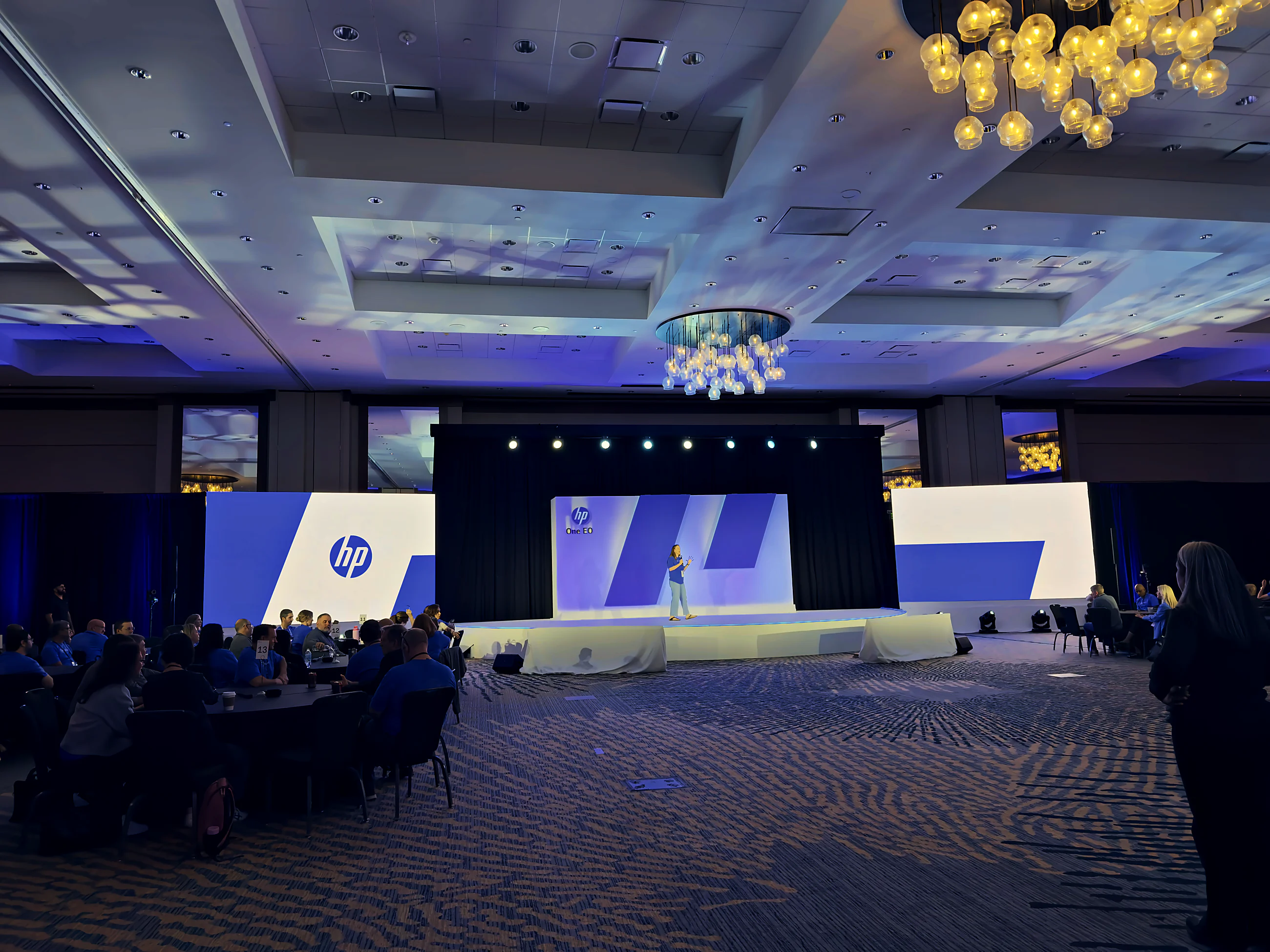 Technology · Exec summit
IMAG
Technology · Exec summit
IMAG
A custom half-circle stage with live IMAG and broadcast.
A fabricated 3D scenic build, a live IMAG (image-magnification) wall with a broadcast stream, and a personalized headshot for every attendee, produced end-to-end.
Read case →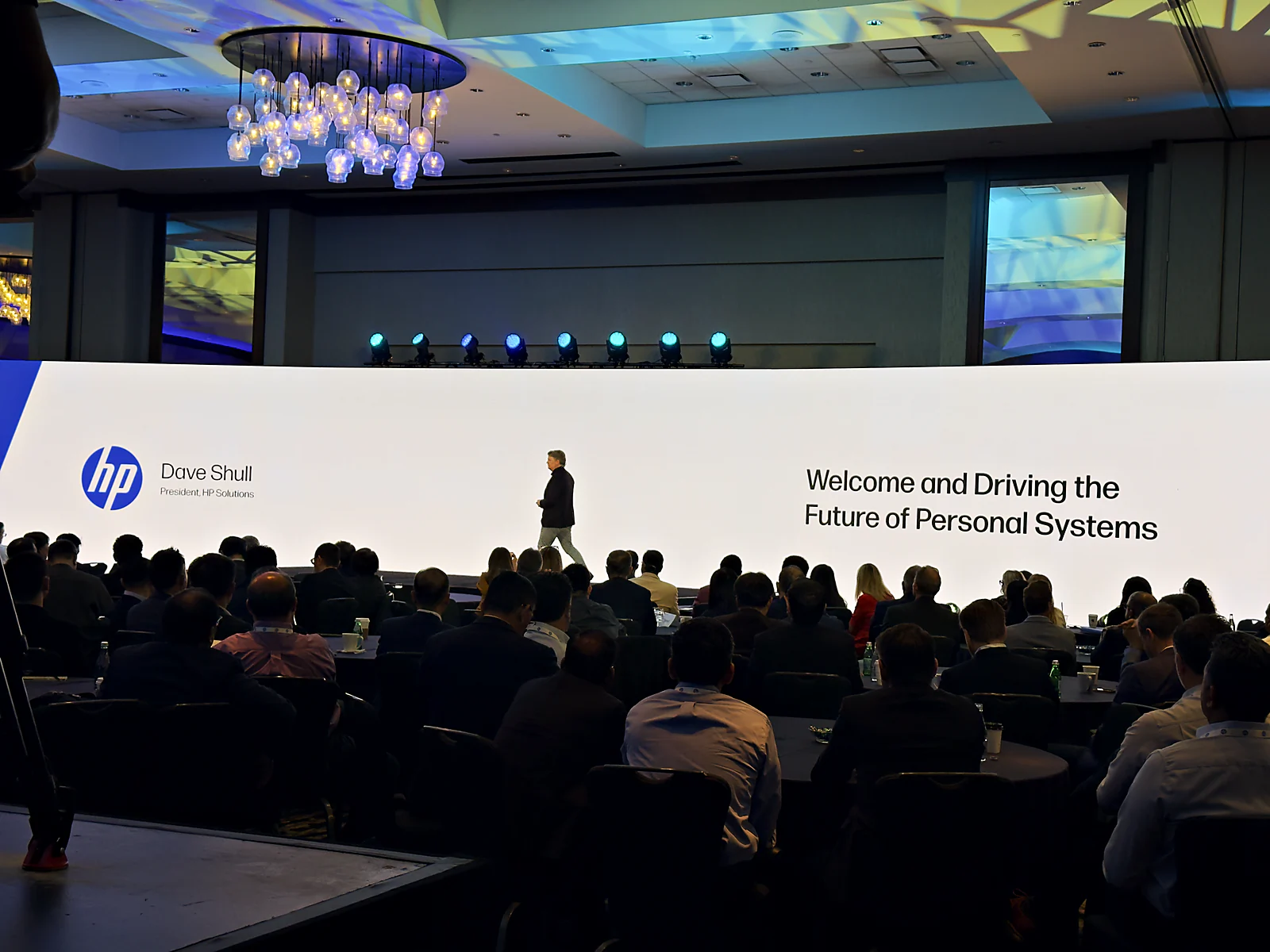 Technology · Supplier summit
8K
Technology · Supplier summit
8K
A supplier summit built on an energy-efficient 8K LED wall.
CAD drafting and 3D renders, a Pisces 8K LED wall, and 4K playback, from design through event management.
Read case →The published ranges run $25K–$60K for single-day AV, $60K–$125K for a single-day flagship, $125K–$300K for a multi-day corporate summit or benefit gala, $300K–$1M for flagship user conferences and sales kickoffs, and $1M+ for global flagships with multi-site broadcast. The full table, and the five levers that move the number, live on the investment guide. Every program is custom. The scoping call turns the range into a figure procurement can hold you to before you commit.
For a Fortune 500 summit, 12–16 weeks gives us enough lead time to lock venues, route trucks, and pre-produce show content. Tight-turn engagements down to 4 weeks are doable with a crew reshuffle. We’ve loaded in on a Wednesday for a 2,000-person Friday keynote. Book the scoping call now and we’ll know by the next business day.
Everything from site survey through strike: staging, LED wall, audio, lighting, video production, broadcast, power, rigging, run of show, speaker rehearsal, graphics, and crew. You get a single SOW, one PM, one invoice, and one number to call at 2 a.m. on the first day of load-in. Change orders are priced, explained, and signed by you before a dollar is spent. The paper trail leads to one person, and that person picks up the phone.
Yes. Flown loads run through the venue’s rigging process, we pull fire-marshal permits in the top US convention metros, and we know each venue’s labor calendar and house crews nationwide. We arrive procurement-ready.
Both. Most clients hand us end-to-end ownership. We sign the contract ourselves and answer for the whole show, not a link in someone else’s chain. When the producer slot is already filled, we run the production and broadcast stack underneath your lead. You get the same team and the same standard, with less of the org chart. Tell us where the seams are and we’ll scope to them.
Hold the date with a producer who’d run your engagement.
Tell us the program, the room, and the date. We come back with a read on the work and a transparent budget range your finance team can review before you commit.